Huawei Ascend 950PR + 'Tau Scaling Law' Challenge NVIDIA
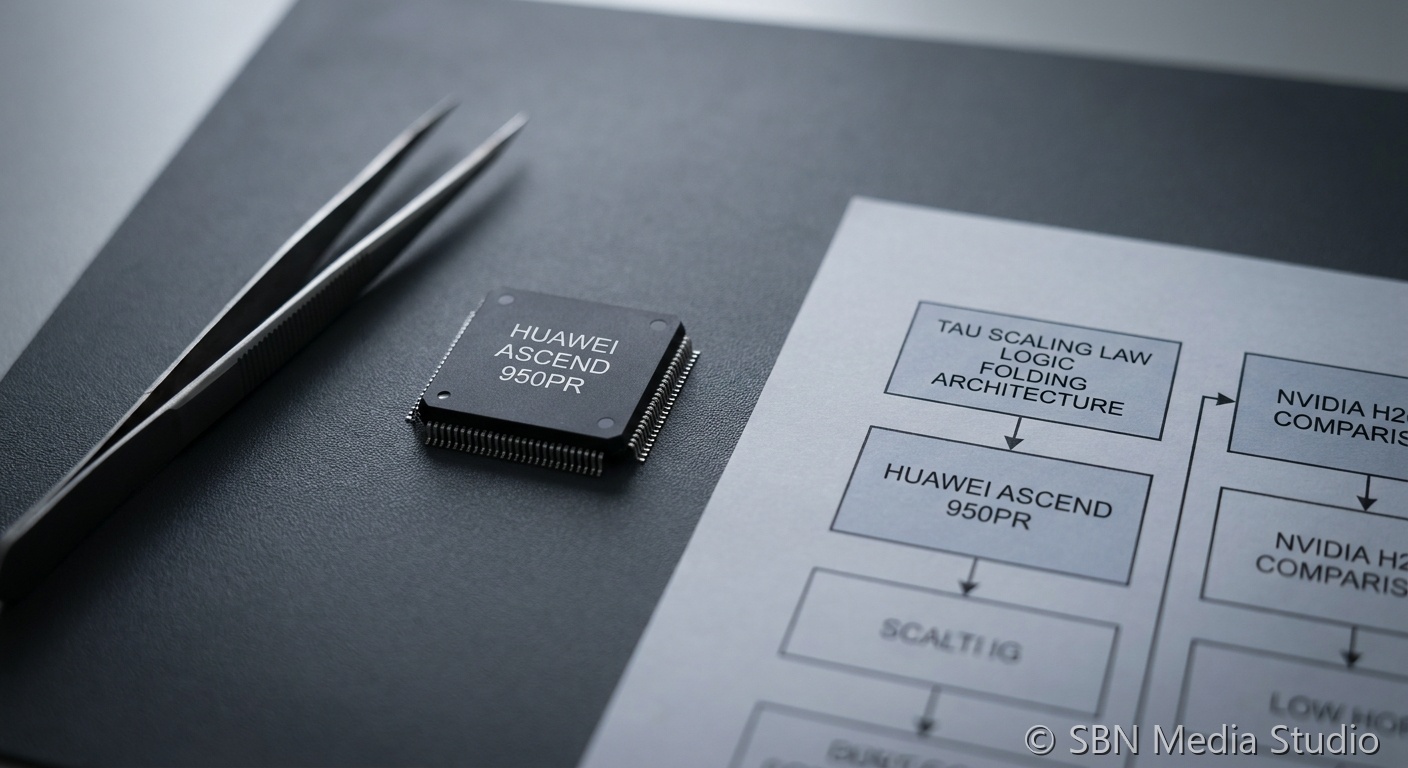
SHENZHEN, JUNE 1, 2026. Huawei unveiled the Ascend 950PR, a 1.56 PFLOP inference accelerator the company claims delivers roughly 2.8x the FP4 throughput of NVIDIA's export-compliant H20, and floated a new architectural pitch it calls the 'Tau Scaling Law' built around a LogicFolding data-movement scheme.
The announcements, detailed by Modern Diplomacy and Tech Insider, are Huawei's strongest attempt yet to reframe the AI-chip conversation away from process-node density, where Chinese fabs remain structurally behind. Ascend 950PR is manufactured on SMIC's N+2 process, broadly equivalent to a TSMC 7nm-class node and roughly two full generations behind the TSMC 3nm that Blackwell and Vera Rubin ship on. Yet Huawei is positioning the part not as a node-for-node competitor but as a workload-specific inference engine, slotted against the H20 that Washington still allows into China under tightened export rules.
The mechanism behind the performance claim is the architecture itself. Tau Scaling Law, as Huawei describes it, shifts the bottleneck argument from FLOPs-per-transistor to bytes-moved-per-joule. LogicFolding pairs compute tiles with on-die SRAM and a redesigned mesh interconnect so that activations for transformer-decoder workloads stay near the unit that needs them, sharply cutting off-chip HBM traffic. If the published 1.56 PFLOPs FP4 figure holds in real workloads — and that is a meaningful 'if' — the part would, on Huawei's own benchmark, leapfrog the H20 on inference economics even while paying a node penalty. Council on Foreign Relations analysis, however, argues the deficit in EUV-grade lithography keeps Huawei structurally behind on both yield and power, no matter how clever the architecture.
The consequences are commercial and geopolitical at once. Huawei is targeting roughly US$12 billion in AI-chip revenue in 2026, a target that hinges on volume Ascend deployments inside Chinese hyperscalers Alibaba, Baidu, and ByteDance, plus state-owned telcos rolling out sovereign inference clusters. If the 950PR holds up to independent benchmarking, NVIDIA's H20 — already a deliberately throttled product — loses its main remaining moat in China, which would accelerate Washington's debate over whether the H20 export window should close entirely. If the benchmarks slip in production, Huawei still wins time and demand-pull from a domestic market that has limited alternatives.
The takeaway is that the China-US chip race is splitting into two distinct contests. On the frontier training side, TSMC 3nm and CoWoS keep NVIDIA ahead by years. On the inference and edge side, where workload-specific architecture matters more than transistor density, Huawei has demonstrated a credible path to compete on systems engineering and software-hardware co-design. 2027 deployments inside Chinese hyperscalers, not press-conference benchmarks, will reveal whether the Tau Scaling Law is a real architectural claim or a marketing wrapper around an old constraint.
Sources
Modern Diplomacy, Tech Insider, Council on Foreign Relations